

Research Skills

E-books are now distributed via VitalSource
VitalSource offer a more seamless way to access the ebook, and add some great new features including text-to-voice. You own your ebook for life, it is simply hosted on the vendor website, working much like Kindle and Nook. Click here to see more detailed information on this process.
Multi-Tiered Systems of Support (MTSS) is an important addition to a long list of initiatives designed to ensure educational equity for all students. Veteran educators will recognize many MTSS strategies as practices they already use, while others may feel uncertain or overwhelmed by yet another framework. This book bridges that gap—grounding MTSS in authentic classroom experience and practical wisdom.Through vivid, real-life stories, the authors illuminate both the complexity and the humanity of school-based work. Drawing on decades of experience—as a classroom teacher and as a school counselor/psychologist—their narratives span from 1982 to the present day, including insights from K–12 settings and university teaching. Each chapter presents a compelling case study highlighting student and classroom engagement across grade levels. These stories invite reflection and dialogue around research-based best practices and educational theory, with each chapter concluding in a transparent explanation of the authors’ professional thinking.Readers will trace the evolution of educational practice over time—from an era when Culturally Responsive Pedagogy was rarely discussed to today’s emphasis on inclusive, socially-constructed learning environments. The book chronicles the profession’s broader shift from behaviorism to social constructivism and demonstrates how that journey informs effective MTSS implementation.The case studies illustrate how culturally responsive practices, data-informed decision making, and authentic relationships with students create the conditions where academic growth, positive behavior, and social-emotional wellness intersect. Universal (Tier I), Targeted (Tier II), and Intensive (Tier III) supports—across academics, behavior, and social-emotional learning—are woven seamlessly throughout.Ideal as an introduction to both the theory and practical application of MTSS, this book offers clarity, compassion, and hard-earned insight. It is designed to spark meaningful discussion in teacher preparation programs, professional learning communities, school buildings, and district leadership teams.Perfect for courses such as: Positive Behavior Supports; Role and Function of a School Psychologist: Positive Behavior Supports (Practicum); Crisis, Trauma Response, and Interventions; Academic Assessment & Intervention; Community, Family, and School Collaboration; Curriculum and Inquiry in Public Schools; Fundamentals of Teaching; Access to Learning in a Pluralistic Society; Teaching Emergent Bilingual Students and Students with Disabilities
More
E-books are now distributed via VitalSource
VitalSource offer a more seamless way to access the ebook, and add some great new features including text-to-voice. You own your ebook for life, it is simply hosted on the vendor website, working much like Kindle and Nook. Click here to see more detailed information on this process.
Transformative Inquiry: Integrating Action Research and Systems Thinking explores how two dynamic methodologies—action research and systems thinking—can be combined to address complex challenges in education, healthcare, organizational leadership, and public policy. Grounded in participatory, iterative processes, both approaches emphasize collaboration, reflection, and systemic improvement. Together, they provide a flexible yet rigorous framework for change.This edited volume brings together scholars and practitioners to examine the historical foundations, theoretical intersections, and applied integration of action research and systems thinking. Chapters include conceptual models and case studies drawn from K–12 schools, higher education, health professions education, digital learning environments, and leadership development. Contributors demonstrate how these frameworks support root-cause analysis, stakeholder engagement, and adaptive interventions that move beyond surface-level solutions.Each chapter illustrates how reflective cycles of inquiry, when combined with systems thinking tools such as feedback loops and mental models, can uncover persistent barriers and guide meaningful, context-sensitive change. Topics include digital equity, culturally responsive pedagogy, instructional redesign, performance improvement, and professional learning.Transformative Inquiry will be of interest to scholars, educators, researchers, and practitioners seeking tools for leading improvement in complex systems. It supports graduate and doctoral-level courses in research methods, systems change, and leadership, as well as professional learning in schools, universities, and organizations.
More
E-books are now distributed via VitalSource
VitalSource offer a more seamless way to access the ebook, and add some great new features including text-to-voice. You own your ebook for life, it is simply hosted on the vendor website, working much like Kindle and Nook. Click here to see more detailed information on this process.
Photovoice research is a participatory qualitative research method where participants photograph themselves, then analyzing them to document and reflect upon their experiences and perspectives on a specific topic, often with the goal of raising awareness and advocating for change. It empowers participants by giving them control over the research process and their own narratives.Photovoice: Using Words and Images in Qualitative Research is a collection of essays from the field that focuses on educators’ implementation of photovoice in a myriad of settings. This methodology crosses disciplines and offers a powerful way to combine visual methods with social research, making it adaptable to many areas where understanding and representing marginalized voices are important.Photovoice is the perfect text for use in a variety of classrooms and courses, including:Introduction to Qualitative Research MethodsCommunity Studies (understanding how visual methods like photovoice can help researchers gain insight into the lived experiences of people within a community)Public Health (photovoice is a valuable method for understanding health disparities, the impact of the environment on health)Education (when studying participatory learning, student engagement, or community-based education. It would also be useful in teacher training programs focusing on inclusive and culturally responsive teaching.)Anthropology (courses on qualitative research or ethnography, photovoice allows for a deeper understanding of cultural and social dynamics through the visual representation of people's lived experiences)Selected topics in Educational ResearchPlace-Based Education
More
E-books are now distributed via VitalSource
VitalSource offer a more seamless way to access the ebook, and add some great new features including text-to-voice. You own your ebook for life, it is simply hosted on the vendor website, working much like Kindle and Nook. Click here to see more detailed information on this process.
Library E-Books
We are signed up with aggregators who resell networkable e-book editions of our titles to academic libraries. These editions, priced at par with simultaneous hardcover editions of our titles, are not available direct from Stylus.
These aggregators offer a variety of plans to libraries, such as simultaneous access by multiple library patrons, and access to portions of titles at a fraction of list price under what is commonly referred to as a "patron-driven demand" model.
Scaffolding the Language of Power: An Apprenticeship in Writing at the Doctoral Level offers an accessible, practical, hands-on guide to developing the skills needed to successfully write a doctoral dissertation or thesis. This textbook-workbook hybrid can be used both as a program/course text and as a supplement for individual doctoral students in education and related social science and humanities fields.The book is built on three main ideas. First, writing is fundamentally connected to issues of social justice. Doctoral-level writing is part of the “language of power” in academia, which builds on the linguistic patterns of the dominant culture and serves as a gatekeeping mechanism. Second, writing is genre-based. This means that doctoral level writing is a particular way of using language, or a specific genre, with distinct rules and structures that can be taught. And third, writing can be scaffolded. Approaching writing as a pedagogical act that supports readers’ understanding through purposeful scaffolding is not just a way to successfully complete a doctoral dissertation—it is a way to make academic writing more accessible in general.In its first chapter, Scaffolding the Language of Power provides a general framework for the rules of the doctoral “language of power.” Chapter two offers an in-depth look at organization and scaffolding as key features of academic writing at the doctoral level, with discussions and activities to practice drafting supportive headings, chunking text, creating road maps and topic sentences, and strategically linking sections, paragraphs, and sentences through transitions and connector phrases. Chapter three provides lessons and exercises to develop argumentation, evidence use, synthesis skills, and academic voice. The remaining six chapters address each major task of the dissertation, including the problem statement, literature review, theoretical framework, methodology, findings, and discussion. Each of these chapters explicitly teaches the purposes and elements of its specific dissertation task, guiding students through warm-ups, annotated examples with elaborated explanations of writing moves, and carefully sequenced activities. Ultimately, these pedagogical features support students to build out the pieces of their doctoral dissertations or theses, chapter by chapter.This book is appropriate for any course on academic writing in EdD or PhD programs. It is also useful for courses that teach how to write a problem statement, literature review, and/or theoretical framework. Additional courses include: Qualitative Research; Qualitative Practicum/pilot study courses; and Dissertation seminar and support courses.CLICK HERE TO BUY THE BOOK/WORKBOOK BUNDLE AND SAVE!CPED Webinar Series--Scaffolding the Language of Power: https://vimeo.com/1029693697
More
E-books are now distributed via VitalSource
VitalSource offer a more seamless way to access the ebook, and add some great new features including text-to-voice. You own your ebook for life, it is simply hosted on the vendor website, working much like Kindle and Nook. Click here to see more detailed information on this process.
Library E-Books
We are signed up with aggregators who resell networkable e-book editions of our titles to academic libraries. These editions, priced at par with simultaneous hardcover editions of our titles, are not available direct from Stylus.
These aggregators offer a variety of plans to libraries, such as simultaneous access by multiple library patrons, and access to portions of titles at a fraction of list price under what is commonly referred to as a "patron-driven demand" model.
Letters to the Field: Curriculum Scholars’ Stories for Future Generations encapsulates a generation of scholars who revitalized the field of Curriculum Studies across North America in the mid-1970s, as well as the generations of scholars who immediately followed, all of whom are now themselves senior scholars. Rather than another edited work of reprints or new monographs, this volume seeks to do something special by providing an opportunity for this group of scholars to speak to their field about understandings they believe to be of significance. The strength of this book generally resides in two overarching factors. First, there is the depth and strength of this well-rounded, highly regarded group of scholars whose work speaks to the heart of the interdisciplinary nature of curriculum studies and curriculum theorizing. Second, as you might imagine, this is a significant moment in the United States when the very foundation of curriculum theory–critical inquiry and often an engagement with questions of race, queerness, disability, and the like–continues to be under attack in K-12 schools and universities across the United States. Contributors speak to the foundations of the field and the contemporary challenges that the field and schools of education more broadly must survive. Contributions to this important work are five to seven handwritten or, in the case of scholars who are unable to write, typed pages. There are also chapters that have accompanying photos and drawings. The reproduction of actual letters in the book lend authenticity and will appeal to readers by giving an intimate view into the thoughts and wishes of these scholars. We also understand that, similar to the challenge folks might face when handwriting a document, some writing might not be legible to all readers. Therefore, stable QR codes and/or hyperlinks to typed versions of handwritten chapters are included so that readers can easily look at typed versions alongside the handwritten work online. Letters to the Field makes an invaluable contribution to Curriculum Studies. By providing a history of the rationale used to revitalize the field, it will prove a valuable addition to the libraries of educators in a variety of disciplines.Perfect for courses such as: Introduction to Curriculum Theory; Introduction to College Teaching; Social Foundations of Education; History of American Higher Education; Traditions of Inquiry; and Introduction to Scholarship
More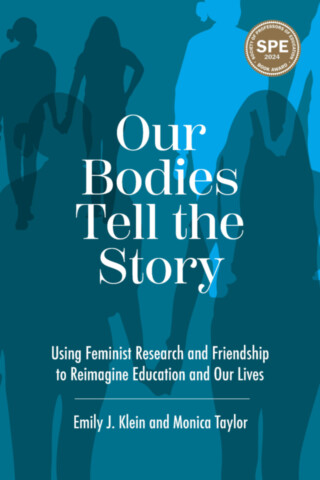
E-books are now distributed via VitalSource
VitalSource offer a more seamless way to access the ebook, and add some great new features including text-to-voice. You own your ebook for life, it is simply hosted on the vendor website, working much like Kindle and Nook. Click here to see more detailed information on this process.
Library E-Books
We are signed up with aggregators who resell networkable e-book editions of our titles to academic libraries. These editions, priced at par with simultaneous hardcover editions of our titles, are not available direct from Stylus.
These aggregators offer a variety of plans to libraries, such as simultaneous access by multiple library patrons, and access to portions of titles at a fraction of list price under what is commonly referred to as a "patron-driven demand" model.
Our Bodies Tell the Story: Using Feminist Research and Friendship to Reimagine Education and Our Lives asks (and answers) a number of critical questions that are key to improving our educational system. How can we use our embodied stories to navigate and disrupt how schools and society reproduce the patriarchy and heteronormativity within our institutions of learning? How do we transgress oppressive boundaries (boundaries cultivated by the patriarchy that have been perpetuated at home, within school, outside of school, in university settings, and in communities) that permit our dehumanization and exclusion? As teachers, professors, and teacher educators, how do we navigate our students’ trauma when we are navigating the re-ignition of our own? This book sets out to tell the story of how the authors have tried to answer these questions in their lives and work. It is the story of a friendship, a partnership, a narrative retelling of their “becoming” as girls, teenagers, women, teachers, wives, daughters, scholars, and mothers. From the earliest memories of their gendered and sexualized childhoods to the present navigation of sexism, heteronormativity, and trauma in the context of teaching and schools, these stories reside in their bodies. They recall, construct, and reexamine, emerging from their dialogues—from talking face-to-face, to email, to FB messenger, poetry, and text. Our Bodies Tell the Story centers around the co/autoethnography of personal narratives, stories, and a kind of survival testimonies, the ways in which the authors bore witness to each other’s lives. The book extensively uses co/autoethnography as a self-study feminist research methodology that takes autoethnography, “a form of self-representation that complicates cultural norms by seeing autobiography as implicated in larger cultural processes” (Taylor & Coia, 2006, p. 278) and moves it beyond the singular to the plural. Using this methodology enables the authors to interweave their stories through dialogue, so that validity, insight, and analysis all emerge in the text. The book investigates the self within the social context of personal relationships, as well as the larger society. Creating a co/autoethnography is a rich, multi-layered endeavor because it is not conducted in a vacuum. As such, it is an important book for faculty and researchers involved in a number of disciplines, including auto/ethnographic research, gender studies, women’s studies, feminist studies, qualitative research and many other areas of study.Perfect for courses such as: Gender and Education │ Public Purposes of Schooling │ Introduction to Gender, Sexuality, and Women's Studies │ Critical Feminisms in Teacher Education │ Gender Issues in Teacher Education
More
E-books are now distributed via VitalSource
VitalSource offer a more seamless way to access the ebook, and add some great new features including text-to-voice. You own your ebook for life, it is simply hosted on the vendor website, working much like Kindle and Nook. Click here to see more detailed information on this process.
Library E-Books
We are signed up with aggregators who resell networkable e-book editions of our titles to academic libraries. These editions, priced at par with simultaneous hardcover editions of our titles, are not available direct from Stylus.
These aggregators offer a variety of plans to libraries, such as simultaneous access by multiple library patrons, and access to portions of titles at a fraction of list price under what is commonly referred to as a "patron-driven demand" model.
Reflecting on Autoethnographic and Phenomenological Experiences: A Caregiver’s Journey is a unique critical qualitative inquiry study that uses the author’s experience as a caregiver to his wife suffering from dementia as the basis of a critical autoethnography. It explores components of positive caregiving that may be not only melancholic and empirical, but also emotionally painful. The book employs multiple approaches that include critical narrative, phenomenology, autoethnography and experiential writing. Through a phenomenological lens of an insider that includes self- and other-hood, marriage, career, fatherhood, suicide, despair, triple grief, loss, caregiving, cooking, housekeeping, advocating mind reading, and encouraging, a narrative illustrating self-reflection on particular experiences is constructed. These culminating experiences result in first-hand and didactical understandings by the caregiver. Individual, personal, and subjective interpretation of relational happenings are explored. Reflective journaling and observations of the seasons of marital life seek to understand if and how shared experiences transcend multiple contexts and help the reader understand experiences of dementia. Reflecting on Autoethnographic and Phenomenological Experiences: A Caregiver’s Journey is a volume that will be invaluable to qualitative inquiry researchers, autoethnographers, and those readers interested in the research of caregiving.
More
E-books are now distributed via VitalSource
VitalSource offer a more seamless way to access the ebook, and add some great new features including text-to-voice. You own your ebook for life, it is simply hosted on the vendor website, working much like Kindle and Nook. Click here to see more detailed information on this process.
Library E-Books
We are signed up with aggregators who resell networkable e-book editions of our titles to academic libraries. These editions, priced at par with simultaneous hardcover editions of our titles, are not available direct from Stylus.
These aggregators offer a variety of plans to libraries, such as simultaneous access by multiple library patrons, and access to portions of titles at a fraction of list price under what is commonly referred to as a "patron-driven demand" model.
Opening Third Spaces for Research in Education challenges dominant educational research methods. It rejects the reductive binaries normalized in social science research—theory/practice, objective/subjective, quantitative/qualitative. Drawing from multiple fields and eras, the book opens third spaces between these artificial poles to help researchers expand interpretations and possibilities for research. Critiquing the current focus on the measurement of “student learning outcomes” and high-stakes assessment, the book offers conceptual tools and case examples to support educators in reconceptualizing research. The book critiques the modernist notion that learning is an individual mental process of acquiring knowledge or skills. It argues instead that learning is inextricably entangled with social relations and cannot be isolated or controlled no matter how scientifically rigorous researchers try to be in their study designs. This challenges the current goal of educational research instruction to design “valid and reliable” studies that provide evidence for “best practices,” and reimagines it as opening third spaces to expand opportunities and approaches for inquiry.Perfect for courses such as: Foundations of Social and Cultural Analysis of Education | Agency, Resistance, and Identity in Education | Critical and Postmodern Pedagogies | Culture, Cognition, and Power Issues in Education | Modernity and Postmodernity in Social Thought and Education | Integrating Research and Practice in Social Justice Education | Cultural Studies in Education | Science, Technology, and Social Research after Eurocentrism | Critical Pedagogy | Language, Performance, and Power | Sociology of Education | Ideology, Racial Politics, and Public Policy: Sociology of Knowledge | Seminar in Cross National Studies of Educational Problems | Participatory Action Research and Programming
More
E-books are now distributed via VitalSource
VitalSource offer a more seamless way to access the ebook, and add some great new features including text-to-voice. You own your ebook for life, it is simply hosted on the vendor website, working much like Kindle and Nook. Click here to see more detailed information on this process.
Library E-Books
We are signed up with aggregators who resell networkable e-book editions of our titles to academic libraries. These editions, priced at par with simultaneous hardcover editions of our titles, are not available direct from Stylus.
These aggregators offer a variety of plans to libraries, such as simultaneous access by multiple library patrons, and access to portions of titles at a fraction of list price under what is commonly referred to as a "patron-driven demand" model.
Researching Resistance: Public Education After Neoliberalism serves two vital functions. First, it explores, explicates, and encourages critical qualitative research that engages the arts and born-digital scholarship. Second, it offers options for understanding neoliberalism, revealing its impact on communities, and resisting it as ideology, practice, and law. The book delves into• strategies for engaging neoliberalism• the Black feminist cyborg theoretical assumptions and intentions of the ethnographic web-based film project• the research and arts-based methodology that walks the fault line between film and ethnography, and• the relationships between the researcher, the activist organizations, and the activism.While the book will focus on neoliberalism within the realm of public education, the implications extend to many other areas of public life. This is an excellent text for classes in qualitative research and public policy. It is the companion text to the digital native ethnographic film project entitled Public Education|Participatory Democracy: After Neoliberalism. Perfect for courses such as: Qualitative Research, Curriculum Studies, Women and Gender Studies, Race and Ethnic Studies, Sociology of Education, Social Justice and Education, Democracy and Civics, Community Engagement, Policy Studies, Service Learning, Education Reform, and Youth Advocacy.
More
E-books are now distributed via VitalSource
VitalSource offer a more seamless way to access the ebook, and add some great new features including text-to-voice. You own your ebook for life, it is simply hosted on the vendor website, working much like Kindle and Nook. Click here to see more detailed information on this process.
Library E-Books
We are signed up with aggregators who resell networkable e-book editions of our titles to academic libraries. These editions, priced at par with simultaneous hardcover editions of our titles, are not available direct from Stylus.
These aggregators offer a variety of plans to libraries, such as simultaneous access by multiple library patrons, and access to portions of titles at a fraction of list price under what is commonly referred to as a "patron-driven demand" model.
These are certainly troubled times in which neoliberal capitalist patriarchy and the tyranny of racism and domination are continually reinscribed on the bodies and lives of so many. However, critical researchers understand the necessity for, as well as the difficulty of, using research to facilitate public transformations that lead to increased justice and equity. The authors contributing to Making Research Public in Troubled Times: Pedagogy, Activism, and Critical Obligations recognize the importance of diverse pedagogies, activism, and ethical choices regarding an environment that supports critical research in oppressive times. Diverse pedagogies that can facilitate the education of critical public researchers across disciplines are illustrated in the first set of chapters addressing questions like: What is important in teaching critical qualitative inquiry? How do students, materials, histories, and the public influence this teaching? What have we learned over years of attempting to teach critical qualitative research methods? The authors in the second section are activist local scholars sharing their projects and explaining what this work means for critical qualitative inquiry. This work includes methods used to incorporate critical qualitative inquiry into community activism. Finally, chapters in the last section focus on future steps and most important actions for the ways critical qualitative inquiry can be conceptualized to address concerns in these troubled times. Perfect for courses such as: Qualitative Research, Curriculum Studies, Women and Gender Studies, International Studies, Social Work, Sociology, Higher Education, Community Engagement, Policy Studies, Service Learning, and Social Justice.
More