
Search results for using data
E-books are now distributed via VitalSource
VitalSource offer a more seamless way to access the ebook, and add some great new features including text-to-voice. You own your ebook for life, it is simply hosted on the vendor website, working much like Kindle and Nook. Click here to see more detailed information on this process.
Library E-Books
We are signed up with aggregators who resell networkable e-book editions of our titles to academic libraries. These editions, priced at par with simultaneous hardcover editions of our titles, are not available direct from Stylus.
These aggregators offer a variety of plans to libraries, such as simultaneous access by multiple library patrons, and access to portions of titles at a fraction of list price under what is commonly referred to as a "patron-driven demand" model.
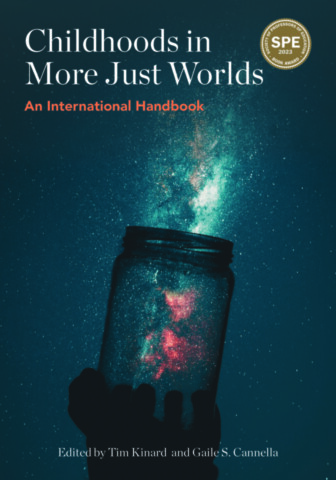
Those who are younger continue to be objects of injustice and inequity; those who are younger, people of color, females, and human beings living in poverty have never been included in equitable performances of justice, care, respect, and fairness.The authors in this international volume use existing social values and institutions--and the strengths of these varied perspectives--to address justice in ways that have not previously been considered. The aim is to create more just worlds for those who are young--as well as for the rest of us.The first set of chapters, Bodies, Beings, and Relations in More Just Worlds, place at the forefront the lives of those who are younger who are commonly situated in positions of invisibility, disqualification, and even erasure. In the second section, Performances of Care and Education for More Just Worlds, the authors acknowledge that needed (re)conceptualizations of those who are younger, along with appreciation for human diversity and entanglements between the so-called human and nonhuman worlds, are the foundations for more just care and education environments. From the critique of neoliberal reform discourses to reconceptualizing human relations with nonhuman animal and material worlds, care and learning environments are rethought. The set of chapters in the final section, Stir of Echoes: 20th Century Childhoods in the 21st, take-up the 20th century critical concerns with constructions of “child” that have dominated and continue to govern perspectives imposed on those who are younger. Suggestions for becoming-with those who are younger through resources like reconceptualist scholarship, Black and Indigenous Studies, and various posthuman perspectives are provided throughout.Whatever the emphasis or focus of a section or chapter, throughout the volume is the recognition that dominant discourses (e.g. neoliberal capitalism, conservativism, progressivism, human exceptionalism) and the policies they create (and that facilitate them), influence possibilities for, and limitations to, more just childhood worlds. Therefore, each section includes chapters that address these complex discourses and policy issues. The reader is invited to engage with these complexities, to become-with the various texts, and to generate unthought possibilities for childhoods in more just worlds.Perfect for courses such as: Curriculum Theory │ Multicultural Education │ Cultural Knowledge of Teachers and Teaching │ Sociocultural Foundations │ Anthropology of Education │ Identity, Agency, and Education │ Race and Ethnic Relations in Schools │ Philosophical Foundations of Education │ Educational Epistemologies │ Theorizing and Researching Teaching and Learning │ Qualitative Research in Education: Paradigms, Theories, and Exemplars │ Epistemologies and Theories in Multicultural and Equity Studies │ Curricular Approaches to Multicultural and Equity Studies in Education │ Culturally Relevant Pedagogy (3) │ Multicultural and Global Perspectives in Teaching and Learning │ Teaching for Social Justice │ Diversity and Equity in Education │ 21st Century Childhood Curriculum │ Childhood and Globalization
More
E-books are now distributed via VitalSource
VitalSource offer a more seamless way to access the ebook, and add some great new features including text-to-voice. You own your ebook for life, it is simply hosted on the vendor website, working much like Kindle and Nook. Click here to see more detailed information on this process.
Library E-Books
We are signed up with aggregators who resell networkable e-book editions of our titles to academic libraries. These editions, priced at par with simultaneous hardcover editions of our titles, are not available direct from Stylus.
These aggregators offer a variety of plans to libraries, such as simultaneous access by multiple library patrons, and access to portions of titles at a fraction of list price under what is commonly referred to as a "patron-driven demand" model.
Scaffolding the Language of Power: An Apprenticeship in Writing at the Doctoral Level offers an accessible, practical, hands-on guide to developing the skills needed to successfully write a doctoral dissertation or thesis. This textbook-workbook hybrid can be used both as a program/course text and as a supplement for individual doctoral students in education and related social science and humanities fields.The book is built on three main ideas. First, writing is fundamentally connected to issues of social justice. Doctoral-level writing is part of the “language of power” in academia, which builds on the linguistic patterns of the dominant culture and serves as a gatekeeping mechanism. Second, writing is genre-based. This means that doctoral level writing is a particular way of using language, or a specific genre, with distinct rules and structures that can be taught. And third, writing can be scaffolded. Approaching writing as a pedagogical act that supports readers’ understanding through purposeful scaffolding is not just a way to successfully complete a doctoral dissertation—it is a way to make academic writing more accessible in general.In its first chapter, Scaffolding the Language of Power provides a general framework for the rules of the doctoral “language of power.” Chapter two offers an in-depth look at organization and scaffolding as key features of academic writing at the doctoral level, with discussions and activities to practice drafting supportive headings, chunking text, creating road maps and topic sentences, and strategically linking sections, paragraphs, and sentences through transitions and connector phrases. Chapter three provides lessons and exercises to develop argumentation, evidence use, synthesis skills, and academic voice. The remaining six chapters address each major task of the dissertation, including the problem statement, literature review, theoretical framework, methodology, findings, and discussion. Each of these chapters explicitly teaches the purposes and elements of its specific dissertation task, guiding students through warm-ups, annotated examples with elaborated explanations of writing moves, and carefully sequenced activities. Ultimately, these pedagogical features support students to build out the pieces of their doctoral dissertations or theses, chapter by chapter.This book is appropriate for any course on academic writing in EdD or PhD programs. It is also useful for courses that teach how to write a problem statement, literature review, and/or theoretical framework. Additional courses include: Qualitative Research; Qualitative Practicum/pilot study courses; and Dissertation seminar and support courses.CLICK HERE TO BUY THE BOOK/WORKBOOK BUNDLE AND SAVE!CPED Webinar Series--Scaffolding the Language of Power: https://vimeo.com/1029693697
More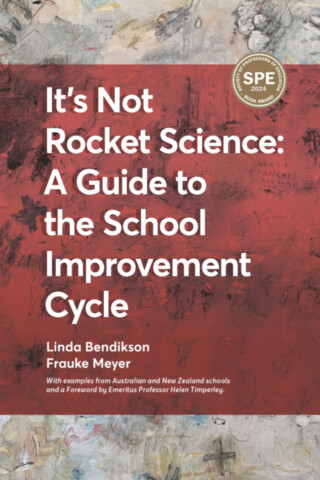
E-books are now distributed via VitalSource
VitalSource offer a more seamless way to access the ebook, and add some great new features including text-to-voice. You own your ebook for life, it is simply hosted on the vendor website, working much like Kindle and Nook. Click here to see more detailed information on this process.
Library E-Books
We are signed up with aggregators who resell networkable e-book editions of our titles to academic libraries. These editions, priced at par with simultaneous hardcover editions of our titles, are not available direct from Stylus.
These aggregators offer a variety of plans to libraries, such as simultaneous access by multiple library patrons, and access to portions of titles at a fraction of list price under what is commonly referred to as a "patron-driven demand" model.
It's Not Rocket Science - A Guide to the School Improvement Cycle: With Examples From New Zealand and Australian Schools presents an easy-to-read, practical guide to effectively leading school improvement. It walks leaders through each step of ‘The School Improvement Cycle’ developed by Bendikson and Meyer, providing case studies, examples, and helpful tools from primary and secondary schools for the implementation of each step. The book will support school leaders in implementing improvement cycles without making the classic mistakes of failing to develop measures of improvement and test change actions before scaling up. Schools and system leaders will benefit greatly from this practical guide, in which Bendikson and Meyer demonstrate that implementing improvement cycles is not a difficult process. While the book uses examples from Australian and New Zealand schools, the lessons that the book teaches can be applied to school leaders everywhere. The authors show how to make the complex work of improving student learning and outcomes at least somewhat simpler. They do this by describing and illustrating improvement steps that they have found to work in practice, providing examples from their work in schools to show the application of these ideas. If implemented properly, the cycles become “self-propelling,” thus reducing the cognitive load involved in planning how to improve. A range of evidence from international research and the authors’ own research and development work in schools explains the cycle and illustrate it. The book is entitled It’s Not Rocket Science because this is the common reaction from leaders once they understand the improvement cycle process. The book is perfect for a variety of courses in Education Leadership, Professional Development, and any other curriculum devoted to improving schools and student performance.Perfect for courses such as: Educational Leadership, Professional Development
More
E-books are now distributed via VitalSource
VitalSource offer a more seamless way to access the ebook, and add some great new features including text-to-voice. You own your ebook for life, it is simply hosted on the vendor website, working much like Kindle and Nook. Click here to see more detailed information on this process.
Library E-Books
We are signed up with aggregators who resell networkable e-book editions of our titles to academic libraries. These editions, priced at par with simultaneous hardcover editions of our titles, are not available direct from Stylus.
These aggregators offer a variety of plans to libraries, such as simultaneous access by multiple library patrons, and access to portions of titles at a fraction of list price under what is commonly referred to as a "patron-driven demand" model.
The term “teacher leadership” is not without its problems, since some interpret it to have both corporate and hierarchical implications. Stewardship as Teacher Leadership: Portraits from the Profession discusses the impact of changing that language to stewardship, a term that is more inclusive, more professional, and more morally-based. At a time when the work of teachers is critiqued and denigrated, the concept of stewardship within the profession better supports the efforts of all teachers, but particularly early career teachers. Stewards have the best interests of the profession at the forefront of their actions. Through the “portraits” of a variety of teachers, readers of Stewardship as Teacher Leadership will engage with and recognize how teachers are stewards as they make intentional and deliberate choices in their daily work that have lasting impacts on their relationships with colleagues, their school programs, and the profession in a multiplicity of ways that traditional teacher leadership models often miss.Perfect for courses in:Foundations of Education | Introduction to Teaching | Student Teaching Seminars | Teacher Leadership | Educational Leadership
More
E-books are now distributed via VitalSource
VitalSource offer a more seamless way to access the ebook, and add some great new features including text-to-voice. You own your ebook for life, it is simply hosted on the vendor website, working much like Kindle and Nook. Click here to see more detailed information on this process.
Library E-Books
We are signed up with aggregators who resell networkable e-book editions of our titles to academic libraries. These editions, priced at par with simultaneous hardcover editions of our titles, are not available direct from Stylus.
These aggregators offer a variety of plans to libraries, such as simultaneous access by multiple library patrons, and access to portions of titles at a fraction of list price under what is commonly referred to as a "patron-driven demand" model.
More than 3,400 colleges and universities in the United States serve 20.5 million students. While each campus is unique, most campuses and institutions face common issues, including tenure and promotion; budgeting; competition among disciplines for space and funding; academic bullying; and issues of identity. These are just a few of the topics among the many vital areas of concern at schools across the country. In Bridges not Blockades, personal essays related to these cultural and political matters will allow faculty and administrators in higher education to see, hear, and better understand the inner workings of our institutions. Perhaps more importantly, this book demonstrates that faculty and staff at colleges and universities need to embrace our commonalities so that we can meet the challenges of higher education throughout the 21st century. Indeed, some of these essays may suggest ways in which faculty, staff, and administrators have moved from differences to commitment to shared goals to tackle new and existing challenges and opportunities.
More
E-books are now distributed via VitalSource
VitalSource offer a more seamless way to access the ebook, and add some great new features including text-to-voice. You own your ebook for life, it is simply hosted on the vendor website, working much like Kindle and Nook. Click here to see more detailed information on this process.
Advancing Special Education Through Improvement Science: A Practical Guide offers a comprehensive and accessible resource for educators, administrators, and policymakers committed to enhancing equity and effectiveness in special education. It bridges the gap between theory and practice by providing a structured approach to applying improvement science within the unique context of special education services. Grounded in the principles of continuous improvement, the book introduces a methodical process for identifying, testing, and refining practices to achieve better outcomes for students with disabilities. It emphasizes the importance of understanding educational systems' complexities and using data-driven strategies to foster lasting change.A key strength of this guide is its focus on the role of data in driving improvement. Readers are guided through practical methods for collecting, analyzing, and using data to inform decisions, along with solutions to common challenges in the process. By centering evidence-based decision-making, the book empowers educators to make meaningful changes that positively impact student outcomes. Collaboration is another major theme. The text highlights the importance of engaging teachers, administrators, families, and students in improvement efforts. Strategies for building strong teams, fostering trust, and ensuring inclusive stakeholder participation are woven throughout, reinforcing the idea that sustainable improvement depends on shared responsibility.Real-world case studies illustrate successful applications of improvement science in diverse school settings. These examples provide readers with insights into implementation challenges and successes, offering practical takeaways that can be adapted for their own contexts. To support day-to-day implementation, the book includes a variety of tools and resources such as data collection templates, PDSA (Plan-Do-Study-Act) cycle checklists, and facilitation guides for collaborative meetings. These practical assets make it easier for educators to incorporate improvement science into their routines.Finally, the guide addresses the critical need for sustainability and scalability. It offers strategies for embedding improvement practices into school and district operations so that gains can be maintained and expanded over time. By focusing on long-term change, the book helps ensure that students with disabilities benefit from ongoing, systemic improvements.Whether you're a classroom teacher, school leader, or policymaker, this guide provides the knowledge and tools needed to drive meaningful progress in special education through improvement science.Perfect for courses such as: Introduction to Special Education; Exceptional Children; Foundations of Special Education; Special Education Leadership; School Improvement and Reform
More
E-books are now distributed via VitalSource
VitalSource offer a more seamless way to access the ebook, and add some great new features including text-to-voice. You own your ebook for life, it is simply hosted on the vendor website, working much like Kindle and Nook. Click here to see more detailed information on this process.
In the changing realm of academic research, Generative Artificial Intelligence (AI) is a significant force, altering the way knowledge is pursued and understood. Enhancing Doctoral Dissertations Ethically with AI: A Comprehensive Guide serves as an indispensable guide for doctoral students and educators on the frontline of this shift, providing clear strategies for integrating generative AI into the dissertation process. The book offers a direct pathway to understanding and applying generative AI in academic work, blending technological insights with the stringent requirements of scholarly research. It presents a pragmatic and ethically informed approach to leveraging AI's capabilities for enhancing data analysis, supporting interdisciplinary research, and navigating the complex ethical considerations associated with AI in academia. Targeted at doctoral researchers looking to harness AI tools in their studies and academic professionals exploring the role of AI in education, this text demystifies the process of integrating advanced AI technologies into research endeavors. Enhancing Doctoral Dissertations Ethically with AI encourages readers to delve into the practical applications of AI, expanding traditional research methodologies and reimagining the scope of academic inquiry. It guides readers through the transformative potential of AI in academic research, offering insights into elevating research projects with innovative AI applications. This book is critically important for a number of readers. Graduate students will benefit from its guidance, researchers can use it as a resource in their work, College of Education faculty can assign it in graduate-level classes, and it is an important addition to institutional libraries.Perfect for courses such as: Dissertation Seminar; Introduction to the Dissertation; Academic Writing; Writing for the Dissertation; Introduction to the Graduate Program; and Doctoral Seminar
More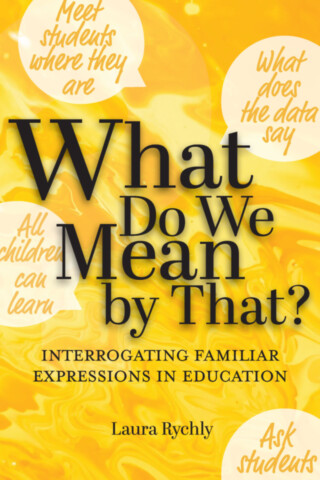
E-books are now distributed via VitalSource
VitalSource offer a more seamless way to access the ebook, and add some great new features including text-to-voice. You own your ebook for life, it is simply hosted on the vendor website, working much like Kindle and Nook. Click here to see more detailed information on this process.
Library E-Books
We are signed up with aggregators who resell networkable e-book editions of our titles to academic libraries. These editions, priced at par with simultaneous hardcover editions of our titles, are not available direct from Stylus.
These aggregators offer a variety of plans to libraries, such as simultaneous access by multiple library patrons, and access to portions of titles at a fraction of list price under what is commonly referred to as a "patron-driven demand" model.
What Do We Mean by That?: Interrogating Familiar Expressions in Education is a collection of essays that opens a space for all educational workers—teachers, teacher educators, administrators, politicians, and others—to unpack commonly used educational phrases and ideas. The idea is to carefully examine what we say to one another when we talk about schools, curriculum, students, and other educational problems or issues—when we say things like “We have to meet students where they are,” and “All children can learn,” or “What does the data say?” What Do We Mean by That? challenges and clarifies such phrases and the how, and why, that they shape educational policies and practices. The influential curricular theorist Dwayne Huebner charged us to always be aware of our “man-made tools,” such as language, and said that since “all educators attempt to shape the world; theorists should call attention to the tools used for the shaping in order that the world being shaped can be more beautiful and just.” Language is a tool in educational practice in myriad ways: between administrators and teachers, teachers and students, teachers and parents, and students and students, as examples. A scripted curriculum is a tool intended to provide fixed language to teachers. It is normal for phrases to make their way into our everyday practices and get lodged there. But we need opportunities to interrupt ourselves and study our language tools to ensure they help create beauty and justice. This collection of thoughtful essays seeks to be this interruption. It is an invaluable tool for improving the educational experience of students and schools.Perfect for courses such as: Foundations of Education; Curriculum Studies; Diversity in Education; Educational Rhetoric and Policy
More
E-books are now distributed via VitalSource
VitalSource offer a more seamless way to access the ebook, and add some great new features including text-to-voice. You own your ebook for life, it is simply hosted on the vendor website, working much like Kindle and Nook. Click here to see more detailed information on this process.
This new and innovative book, Improving Your College Courses: A Guide for Engaging in Digital Learning, provides instructors from any discipline with a guide for improving course quality and engaging learners in digital learning environments. It inspires professional development and learning (PDL) by making available an indispensable resource for higher education faculty seeking to enhance their teaching practices, propel meaningful experiences, and improve student outcomes. Instructors and administrators will want to read this research-informed, practical book authored by faculty with expertise in digital learning environments. All of them have published on this topic, some earning digital certifications and online teaching awards. Faculty and administrators attracted to a blend of theoretical insights and practical applications will welcome a solid resource for instructors engaged in continuous course improvement and PDL. At the same time, administrators overseeing faculty development as well as mentoring coordinators who sponsor PDL around instructional effectiveness and ethics will benefit from the use of the volume. Professors will find strategies that can be immediately implemented in their courses, making them a valuable tool for PDL. It will be a “must have” for new instructors and faculty who are adapting their teaching for a digital world. The book covers essential topics including course introduction; content and materials; engagement activities; accessibility and usability; and support strategies; as well as practical methods such as case studies, glossary, and appendix and supplementary materials with web content. Improving Your College Courses features pictures, figures, drawings, charts, and graphs designed to clearly illustrate the steps and concepts narrated. This book is designed to be an indispensable resource for educators seeking to enhance their teaching practices and improve student outcomes.Carol A. Mullen is the recipient of the 2026 Excellence in Research Award, AERA Division A: Administration, Organization, and Leadership. Watch a clip of her acceptance speech at: https://youtu.be/W5Ao9bGZrF0
More
E-books are now distributed via VitalSource
VitalSource offer a more seamless way to access the ebook, and add some great new features including text-to-voice. You own your ebook for life, it is simply hosted on the vendor website, working much like Kindle and Nook. Click here to see more detailed information on this process.
Library E-Books
We are signed up with aggregators who resell networkable e-book editions of our titles to academic libraries. These editions, priced at par with simultaneous hardcover editions of our titles, are not available direct from Stylus.
These aggregators offer a variety of plans to libraries, such as simultaneous access by multiple library patrons, and access to portions of titles at a fraction of list price under what is commonly referred to as a "patron-driven demand" model.
What are the elements of culturally responsive and sustaining instruction? How can these elements be implemented in classrooms? One of the most effective methods of addressing these issues is the Culturally Responsive Instruction Observation Protocol (CRIOP), which is being used in school districts nationwide to guide teacher professional development. A Framework for Culturally Responsive Practices presents scholarship in second language acquisition, sociolinguistics, culturally appropriate assessment, educational anthropology, educational psychology, instruction, and critical pedagogy to provide guidance to those who strive to teach in ways that meet the needs of a diverse student population. The book is a culmination of the authors’ many years of experience as both researchers and instructional coaches in schools, presenting a comprehensive portrait of the research and practices associated with culturally responsive teaching. Each chapter showcases a different element of the CRIOP, providing supporting research as well as ways to implement the element in K-8 classrooms. The book also includes several specific examples written by teachers in the field and a comprehensive bibliography. This is a practical guide that can be used in a variety of courses for pre-service teachers as well as by teachers and administrators in school districts across the country.Perfect for courses such as: Teaching in a Diverse Society, Multicultural Education, Effective Teaching Practices in Elementary/Middle School, Cultural and Social Foundations of Education, Teaching Diverse Populations, Sociocultural Perspectives in Education, Educational Perspectives in a Global Society, Educational Inequality, Urban Studies
More