
Search results for making sense of rac

E-books are now distributed via VitalSource
VitalSource offer a more seamless way to access the ebook, and add some great new features including text-to-voice. You own your ebook for life, it is simply hosted on the vendor website, working much like Kindle and Nook. Click here to see more detailed information on this process.
Library E-Books
We are signed up with aggregators who resell networkable e-book editions of our titles to academic libraries. These editions, priced at par with simultaneous hardcover editions of our titles, are not available direct from Stylus.
These aggregators offer a variety of plans to libraries, such as simultaneous access by multiple library patrons, and access to portions of titles at a fraction of list price under what is commonly referred to as a "patron-driven demand" model.
Opening Third Spaces for Research in Education challenges dominant educational research methods. It rejects the reductive binaries normalized in social science research—theory/practice, objective/subjective, quantitative/qualitative. Drawing from multiple fields and eras, the book opens third spaces between these artificial poles to help researchers expand interpretations and possibilities for research. Critiquing the current focus on the measurement of “student learning outcomes” and high-stakes assessment, the book offers conceptual tools and case examples to support educators in reconceptualizing research. The book critiques the modernist notion that learning is an individual mental process of acquiring knowledge or skills. It argues instead that learning is inextricably entangled with social relations and cannot be isolated or controlled no matter how scientifically rigorous researchers try to be in their study designs. This challenges the current goal of educational research instruction to design “valid and reliable” studies that provide evidence for “best practices,” and reimagines it as opening third spaces to expand opportunities and approaches for inquiry.Perfect for courses such as: Foundations of Social and Cultural Analysis of Education | Agency, Resistance, and Identity in Education | Critical and Postmodern Pedagogies | Culture, Cognition, and Power Issues in Education | Modernity and Postmodernity in Social Thought and Education | Integrating Research and Practice in Social Justice Education | Cultural Studies in Education | Science, Technology, and Social Research after Eurocentrism | Critical Pedagogy | Language, Performance, and Power | Sociology of Education | Ideology, Racial Politics, and Public Policy: Sociology of Knowledge | Seminar in Cross National Studies of Educational Problems | Participatory Action Research and Programming
More
E-books are now distributed via VitalSource
VitalSource offer a more seamless way to access the ebook, and add some great new features including text-to-voice. You own your ebook for life, it is simply hosted on the vendor website, working much like Kindle and Nook. Click here to see more detailed information on this process.
Hauntings, Remembering, and Aesthetics offers an intimate, artful exploration of what is lost—and what remains—when schools are closed. Grounded in the stories of two shuttered public schools in Chicago, it weaves together research, narrative, memory, and visual art to honor the communities shaped by these institutions and reckon with the systemic forces that led to their closure. Drawing from archival research, local records, personal memories, and conversations with former students, educators, and community members, the author—who has a personal connection to each school—reconstructs the histories left behind by braiding their voices with collages and photographs. The book makes visible the deep ties between school communities and the neighborhoods they served. This powerful storytelling serves as a prompt for reflection and reconsideration of school closures.The portraits that emerge tell of schools that operated under immense financial strain but built strong, nurturing environments through resourcefulness and relationships. Participants recall staff who shaped their lives, naming teachers and leaders as transformative figures in their youth. They speak openly about the racism, classism, and broken promises surrounding public education in gentrifying neighborhoods—where public housing was demolished and communities were displaced. In their words, school closures were not isolated policy decisions but outcomes of a broader inequality and disinvestment. Far from passive witnesses, these community members critically examine the past, theorizing their experiences and naming the systemic failures that framed them. They express a desire to pause, reflect, and remember—to reclaim the memory of their schools as spaces of resilience, joy, and collective resistance. As one participant shared, “There’s so much history in us.” That history, the book argues, is too often erased in mainstream narratives about school closures. By presenting these stories through both visual and literary forms, the book creates a new kind of archive—one grounded in lived experiences and presented through aesthetics. It invites educators, parents, policymakers, journalists, and anyone invested in public education to listen differently: to hear what was lost when the schools closed, and to recognize what still echoes in the voices of those who remember.This is not just a story of the past—it is a call to action in the present through stories that have always been here. These acts of remembering resist the dominant, data-driven narratives that often justify school closures. It reveals the human cost of policies disconnected from community realities and asks us to imagine more just futures for public education in our cities. This book asks us to see and hear stories anew, through the haunting beauty of memory, artwork, and collective reflection.Perfect for courses such as: Social Foundations of Education; Educational Policy Studies; History of Urban Education; Sociology of Education; Teacher Education in Urban Education; Historical and Cultural Contexts of Urban Education; Qualitative Research Methods; Arts-based Research Methods; Visual Research Methods
More
E-books are now distributed via VitalSource
VitalSource offer a more seamless way to access the ebook, and add some great new features including text-to-voice. You own your ebook for life, it is simply hosted on the vendor website, working much like Kindle and Nook. Click here to see more detailed information on this process.
Library E-Books
We are signed up with aggregators who resell networkable e-book editions of our titles to academic libraries. These editions, priced at par with simultaneous hardcover editions of our titles, are not available direct from Stylus.
These aggregators offer a variety of plans to libraries, such as simultaneous access by multiple library patrons, and access to portions of titles at a fraction of list price under what is commonly referred to as a "patron-driven demand" model.
Novice and early career researchers often have difficulty with understanding how theory, data analysis and interpretation of findings “hang together” in a well-designed and theorized qualitative research investigation and with learning how to draw on such understanding to conduct rigorous data analysis and interpretation of their analytic results. Data Analysis, Interpretation, and Theory in Literacy Studies Research demonstrates how to design, conduct and analyze a well put together qualitative research project. Using their own successful studies, chapter authors spell out a problem area, research question, and theoretical framing, carefully explaining their choices and decisions. They then show in detail how they analyzed their data, and why they took this approach. Finally, they demonstrate how they interpreted the results of their analysis, to make them meaningful in research terms. Approaches include interactional sociolinguistics, microethnographic discourse analysis, multimodal analysis, iterative coding, conversation analysis, and multimediated discourse analysis, among others. This book will appeal to beginning researchers and to literacy researchers responsible for teaching qualitative literacy studies research design at undergraduate and graduate levels.
More
E-books are now distributed via VitalSource
VitalSource offer a more seamless way to access the ebook, and add some great new features including text-to-voice. You own your ebook for life, it is simply hosted on the vendor website, working much like Kindle and Nook. Click here to see more detailed information on this process.
Library E-Books
We are signed up with aggregators who resell networkable e-book editions of our titles to academic libraries. These editions, priced at par with simultaneous hardcover editions of our titles, are not available direct from Stylus.
These aggregators offer a variety of plans to libraries, such as simultaneous access by multiple library patrons, and access to portions of titles at a fraction of list price under what is commonly referred to as a "patron-driven demand" model.
Cartographies of Blackness and Black Indigeneities acknowledges the saliency of Blackness in contemporary social formations, insisting that how bodies are read is extremely important. The contributors to this volume elicit or produce both tangible and intangible social, political, material, spiritual and emotional effects and consequences on Black and African bodies, globally. It is a call to celebrate Blackness in all its complexities, including race, ethnicity, class, gender, sexuality, (dis)ability, spiritualities, and geographies. Understanding Blackness is to insist on Black and African political and cultural appreciation of the phenomenon outside of Euro-colonial attempts to regulate and define how Black and African bodies are perceived. This book intersperses discussions of Blackness with Black racial identity and cultural politics and the required responsibilities for the Global Black and African populations to build viable communities utilizing our differences—knowledges, cultures, politics, identities, histories—as strengths.
More
E-books are now distributed via VitalSource
VitalSource offer a more seamless way to access the ebook, and add some great new features including text-to-voice. You own your ebook for life, it is simply hosted on the vendor website, working much like Kindle and Nook. Click here to see more detailed information on this process.
Library E-Books
We are signed up with aggregators who resell networkable e-book editions of our titles to academic libraries. These editions, priced at par with simultaneous hardcover editions of our titles, are not available direct from Stylus.
These aggregators offer a variety of plans to libraries, such as simultaneous access by multiple library patrons, and access to portions of titles at a fraction of list price under what is commonly referred to as a "patron-driven demand" model.
In what ways can performance be mobilized to resist? This is the question that the present volume explores from within the context of qualitative research. From an arts-based approach, authors suggest methods on how artistic practice resists. The volume addresses how critical performance autoethnography might retain its ethical and democratic potential without falling into dogmatism or hegemony. This vision for democracy can even be accomplished through improvised, process-centered pieces that weave together thoughts from several key scholars, all to give us a critical perspective on how performative autoethnography is paradigmatically situated. The performance texts collected here question and resist, showing how the experience of art-making can move us through political and public spaces with liberatory potential, challenging social and ideological hegemonies and to generate social movements. Imaginative arts-based practices allow us access to emotional and embodied phenomena that remain otherwise foreclosed by traditional forms of inquiry. From poetics to public performances, subversive interventions, and more, these chapters bring a radical performative discourse to the fore. In so doing, the chapters work to create a framework for just performance, showing us how we might live performance as resistance.
More
E-books are now distributed via VitalSource
VitalSource offer a more seamless way to access the ebook, and add some great new features including text-to-voice. You own your ebook for life, it is simply hosted on the vendor website, working much like Kindle and Nook. Click here to see more detailed information on this process.
Photovoice research is a participatory qualitative research method where participants photograph themselves, then analyzing them to document and reflect upon their experiences and perspectives on a specific topic, often with the goal of raising awareness and advocating for change. It empowers participants by giving them control over the research process and their own narratives.Photovoice: Using Words and Images in Qualitative Research is a collection of essays from the field that focuses on educators’ implementation of photovoice in a myriad of settings. This methodology crosses disciplines and offers a powerful way to combine visual methods with social research, making it adaptable to many areas where understanding and representing marginalized voices are important.Photovoice is the perfect text for use in a variety of classrooms and courses, including:Introduction to Qualitative Research MethodsCommunity Studies (understanding how visual methods like photovoice can help researchers gain insight into the lived experiences of people within a community)Public Health (photovoice is a valuable method for understanding health disparities, the impact of the environment on health)Education (when studying participatory learning, student engagement, or community-based education. It would also be useful in teacher training programs focusing on inclusive and culturally responsive teaching.)Anthropology (courses on qualitative research or ethnography, photovoice allows for a deeper understanding of cultural and social dynamics through the visual representation of people's lived experiences)Selected topics in Educational ResearchPlace-Based Education
More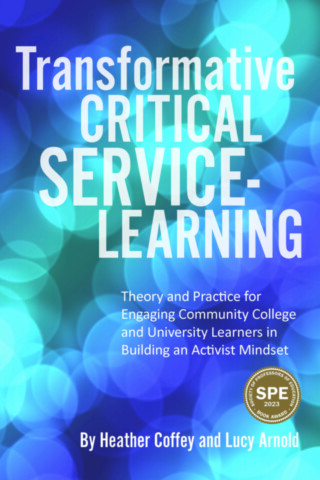
E-books are now distributed via VitalSource
VitalSource offer a more seamless way to access the ebook, and add some great new features including text-to-voice. You own your ebook for life, it is simply hosted on the vendor website, working much like Kindle and Nook. Click here to see more detailed information on this process.
Library E-Books
We are signed up with aggregators who resell networkable e-book editions of our titles to academic libraries. These editions, priced at par with simultaneous hardcover editions of our titles, are not available direct from Stylus.
These aggregators offer a variety of plans to libraries, such as simultaneous access by multiple library patrons, and access to portions of titles at a fraction of list price under what is commonly referred to as a "patron-driven demand" model.
Transformative Critical Service-Learning offers hands-on tools for implementing, reflecting on, and assessing critical service-learning in classrooms and community spaces. Answering a need from practitioners for a practical tool for making sense of critical service-learning, the authors introduce the Critical Service-Learning Implementation Model as a way to encourage conversations among stakeholders. Materials include specific criteria to examine, examples of application and context, and ways to incorporate the model into reflective practices. Valuing partnerships, reflection, and analysis of power dynamics, the research and strategies offered here provide an entry point for faculty new to critical service-learning, while also offering new ideas and tools for long-time practitioners. Chapters offer particular attention to strategies for engaging students, syllabus development, and reflective cycles. Additionally, the authors offer a model for faculty development in the area of critical service-learning at the institutional level, including suggestions for faculty and administrators interested in increasing engagement with social justice and community spaces. As institutions of higher education are focusing more on the ways in which they can meet the needs of the communities surrounding their campuses, The Carnegie Foundation’s Elective Classification for Community Engagement provides a special-purpose designation for higher education institutions with commitments in the area of community engagement. Universities must commit to institutional change in order to improve the outcomes for the communities surrounding the campus. The classification framework represents best practices in the field and encourages continuous improvement through periodic re-classification. Service-learning has been identified as one of the more effective methods for engaging undergraduate and graduate students in community engaged scholarship, which facilitates development of critical inquiry, understanding needs assessment, and deep reflection on inequality. The authors intend this book to benefit university faculty endeavoring to begin or develop service-learning courses, higher education administrators who want to train and engage university faculty in adopting a more community engaged teaching model, and P-12 teachers, who often serve as community partners with higher education institutions to facilitate justice-oriented approaches to teaching their diverse students.Perfect for courses such as: Critical Thinking and Communication/Service-Learning │ Service-Learning Capstone │ Pathways to Effective Community Engagement │ School and Community Collaboration │ Teaching to Transform Society │ Food, Environment, and Sustainability │ Race and the Right to Vote in the US │ Education and Society │ Environmental Education │ Race, Place, and Memory
More
E-books are now distributed via VitalSource
VitalSource offer a more seamless way to access the ebook, and add some great new features including text-to-voice. You own your ebook for life, it is simply hosted on the vendor website, working much like Kindle and Nook. Click here to see more detailed information on this process.
Light a Fire and Watch It Burn: Disruptive Qualitative Methods in Education Research revolutionizes how qualitative research is conceptualized, taught, and practiced. Edited by Michael L. Boucher, Jr., Ph.D., this groundbreaking collection of essays by emerging and established scholars introduces equity-centered, justice-oriented methodologies designed to challenge entrenched systems of power and privilege. With a focus on amplifying marginalized voices and fostering transformative social action, this book serves as an inspiring, accessible resource for educators, researchers, and graduate students.Traditional qualitative research texts provide invaluable foundations for understanding methods such as participant observation, coding, and analysis. Yet, they often fail to address innovative approaches that challenge oppressive norms and center lived experiences of marginalized communities. Light a Fire and Watch It Burn fills this critical gap, presenting 15 concise, practice-oriented chapters on disruptive methods, including photovoice, duoethnography, feminist critical discourse analysis, and arts-based research like ethnodrama. These approaches reimagine qualitative inquiry as a vehicle for equity, inclusion, and justice, equipping readers with tools to create meaningful change.Each chapter follows a consistent structure, making the book an ideal classroom text for qualitative research courses. Readers will find clear explanations of the methodologies, their theoretical foundations, and how they disrupt systems of oppression while empowering participants. Practical examples, discussion questions, and curated lists of further readings encourage deep reflection and active engagement. This structure ensures seamless integration into weekly lessons for master’s and doctoral students, while also serving as a reference for scholars seeking to expand their methodological repertoire.From exploring anticolonial ethics to embracing culturally responsive frameworks like ʻŌiwi methodologies and Pláticas, the book highlights the potential of qualitative research to humanize and transform. Contributors share personal narratives and research experiences that illuminate how these methodologies foster trust, amplify silenced voices, and dismantle academic hierarchies. The metaphor of “lighting a fire” reflects the catalytic potential of these methods to spark curiosity, disrupt traditional paradigms, and ignite transformative social action, while “watching it burn” underscores the boldness and urgency of these practices in reimagining education research.Accessible, inspiring, and deeply rooted in critical theory, Light a Fire and Watch It Burn is an essential companion for students and educators who dare to confront power and reimagine research as a tool for justice. It challenges readers to move beyond the safe confines of traditional methods and embrace innovative practices that center humanity, equity, and resilience. Whether you are a graduate student beginning your journey, a scholar seeking to disrupt academic norms, or an educator looking for practical tools to inspire your students, this book provides the guidance and vision needed to reshape qualitative research—and, ultimately, the world it seeks to understand. Light a Fire and Watch It Burn is not just a book; it is a call to action for those ready to create a more inclusive, equitable future through research.Perfect for courses such as: Introduction to Qualitative Research Methods; Critical Theory in Education; Advanced Qualitative Research Design; Participatory Research in Education; Feminist Research in Social Sciences; Decolonizing Research Practices; Arts and Humanities-Based Inquiry; Social Justice in Education; Education Policy and Practice; Research Ethics and Methodologies
More
E-books are now distributed via VitalSource
VitalSource offer a more seamless way to access the ebook, and add some great new features including text-to-voice. You own your ebook for life, it is simply hosted on the vendor website, working much like Kindle and Nook. Click here to see more detailed information on this process.
Recipes of Motherhood: Families, Communities, and the Power of Food Narratives delves into the powerful connections between food, culture, and motherhood within the demanding context of higher education. This thought-provoking volume, edited by Mila Zhu and Sarah Morrison, brings together diverse voices of academic mothers who share how food practices shape, sustain, and empower their lives as they navigate the complex terrain of career, family, and cultural identity. Drawing from personal narratives, case studies, and interdisciplinary research, Recipes of Motherhood illuminates the ways in which food serves as more than sustenance; it becomes a source of resilience, a tool for community-building, and a means of preserving cultural heritage. The academic mothers in this volume reveal how food acts as a metaphor and medium for navigating life’s challenges, allowing them to bridge their personal and professional identities. From adapting family recipes to sharing meals that create community, each story uncovers the unique strategies academic mothers use to sustain themselves and those around them in an environment that can often feel isolating. Grounded in feminist theory, food studies, and cultural memory, this book highlights how food stories are deeply intertwined with questions of gender, tradition, and self-identity. Chapters explore themes such as the symbolic role of food in cultural heritage, food as a form of resistance to institutional expectations, and culinary traditions as a way to build solidarity among women in academia. Through these narratives, Recipes of Motherhood provides a nuanced understanding of how food can act as both a grounding force and a form of empowerment in academic mothers’ lives. With its interdisciplinary approach, the book appeals not only to scholars in cultural studies, food studies, and gender studies but also to students, educators, and anyone interested in the transformative power of food. Readers will find in these pages a rich tapestry of stories that inspire, educate, and challenge traditional ideas about motherhood and academia. Perfect for academic courses and personal reading alike, the volume offers insight into how food serves as a vital element in the journey of academic mothers, helping them navigate the intersections of personal identity, professional resilience, and cultural expression. This volume invites readers to savor the complexities of academic motherhood through the lens of food and to consider how everyday acts of cooking and sharing meals can hold deep significance in our lives and our communities. Whether you are a mother, an educator, or simply someone interested in the stories that food can tell, Recipes of Motherhood is a captivating exploration of how culinary practices shape our relationships, our work, and our sense of self. Join us in celebrating the resilience, creativity, and heritage of academic mothers whose food stories nourish not only their families but also the broader academic community.Perfect for courses such as: Gender Studies / Women’s Studies – Motherhood and Identity; Food Studies – Cultural Narratives in Food Practices; Education Studies – Women in Academia: Challenges and Resilience; Sociology – Family and Society: Gender Roles and Cultural Heritage; Anthropology – Food, Culture, and Identity; Cultural Studies – Folklore, Tradition, and Modern Identities; Parenting and Family Studies – Motherhood and Work-Life Balance; Interdisciplinary Studies – Food as Narrative and Social Practice; Feminist Theory – Intersectionality of Motherhood, Career, and Culture; Psychology of Women – Resilience and Identity in Motherhood
More
E-books are now distributed via VitalSource
VitalSource offer a more seamless way to access the ebook, and add some great new features including text-to-voice. You own your ebook for life, it is simply hosted on the vendor website, working much like Kindle and Nook. Click here to see more detailed information on this process.
Promoting a growth mindset in PreK-12 schools is a valuable educational trend, based on the idea that students who believe they can grow and improve will succeed more easily. However, when students struggle academically, there’s often an undergirded assumption that they—and sometimes their families—are not trying hard enough or they just need to fit into a standardized mold. This deficit thinking places blame on students’ perceived limitations and can lead to lower expectations or biases toward students who come from diversified backgrounds, encompassing ability, socioeconomic status, race, language, gender, or culture. As an alternative approach, this book promotes the universal adoption of Asset-Based Practices (ABPs). ABPs encourage educators to see and honor the strengths in each student’s identity. ABPs shift our focus to the assets that students and families bring into the classroom, viewing differences as resources rather than obstacles. This means recognizing and building on students’ cultural, linguistic, and community-based knowledge to make learning richer and more inclusive for everyone.Implementing an asset-based approach can transform our classrooms. Research shows that students perform better and feel more motivated when they’re recognized and valued for who they are. Bringing students’ lived experiences into the curriculum can help them develop positive identities and a stronger sense of belonging, which boosts their academic and social growth. Instead of focusing on “fixing” students, ABPs ask us to adapt our teaching to connect with students’ cultural backgrounds and experiences, coupled with recognizing the wealth of knowledge that students bring from their families and communities.Switching to an asset-based approach helps us move away from simply encouraging perseverance or grit in students. Instead, it invites us to take responsibility for creating an environment where every student feels they belong and can succeed. With ABPs, we’re able to create more inclusive and affirming classrooms for all students, where their identities are seen as strengths, not obstacles, and where their cultural, linguistic, and community knowledge is a foundation for learning.Innovative and creative methodologies and practices that aspiring and practicing educators can use right away are the primary focus of this book. Because the editors and contributors are former or current PreK-12 practitioners, and many are also educational scholars, this book is written for a broad educational audience. Moving from Growth to Asset-Based Mindsets is for both preservice and practicing teachers across PreK-12 grade levels, school types, and geographic regions looking to improve their practice. To accomplish this, the editors and contributors provide entry points for transforming the educational landscape in favor of liberatory, asset-based practices in PreK-12 schools.Additionally, this book is ideal for teacher and administrator preparation programs, as well as PreK-12 professional development, because it guides readers through theoretical and empirical discussions, supported by hands-on applications that enable real-time application, and concludes with interactive features, like case studies, extension activities, and discussion prompts.Perfect for courses such as: Introduction to Educating For Equity And Social Justice; Introduction to Cultivating Culturally Responsive Classrooms; Foundations Of Culturally And Linguistically Responsive Practice; Introduction to Diversity, Equity, and Inclusion in Schools; Introduction To School Improvement, Introduction to Teacher Leadership And School Improvement; Introduction to Curriculum, Instruction, and Assessment; Principles of Teaching Diverse Learners; Introduction to Multiculturalism in Education
More