

Paul C. Pribbenow
Paul C. Pribbenow, Ph.D. is the 10th president of Augsburg University, an institution affiliated with the Evangelical Lutheran Church in America (ELCA) and located in heart of Minneapolis. Since joining Augsburg in 2006, Pribbenow has enhanced the College’s role as an active community partner in its urban setting and has led a comprehensive strategic planning process known as Augsburg150, which names the university’s signature commitments to equity, inclusion, and community engagement. Pribbenow also has led unprecedented fundraising efforts at Augsburg, including $55 million to build the Hagfors Center for Science, Business, and Religion, a signature academic building; and $129 million in the Sesquicentennial “Great Returns” campaign.
Pribbenow serves on the national boards of Campus Compact and the Coalition for Urban and Metropolitan Universities. He also is active in the Anchor Institutions Task Force. Locally, he chairs the Cedar-Riverside Partnership and serves on the Executive Committee of the Minnesota Private College Council. Before coming to Augsburg, Pribbenow served as president of Rockford College (now Rockford University) in Rockford, Illinois. He also has served as research fellow for the Center of Inquiry in the Liberal Arts at Wabash College (Indiana); dean for College Advancement and secretary of the Board of Trustees at Wabash College; vice president of the School of the Art Institute of Chicago; and associate dean of the Divinity School of the University of Chicago.
Pribbenow holds a BA from Luther College (Iowa), and an MA (1979) and PhD (1993) in social ethics from the University of Chicago. He received the Distinguished Service Award at Luther College in 2008; the William Burke Award for Presidential Leadership in Experiential Education in 2012; the Professional Fundraiser of the Year from the Association of Fundraising Professionals (AFP) in 2019; and the University of Chicago Divinity School Alumnus of the Year Award in 2025.
Books by Paul C. Pribbenow:

E-books are now distributed via VitalSource
VitalSource offer a more seamless way to access the ebook, and add some great new features including text-to-voice. You own your ebook for life, it is simply hosted on the vendor website, working much like Kindle and Nook. Click here to see more detailed information on this process.
Higher education in the United States appears to be in trouble. Much of the American public sees colleges and universities as disengaged, elitist, not open to new or alternative ideas, something to be escaped—not to mention expensive, unproductive, out of touch, unaccountable, oblivious to their own failings, and increasingly irrelevant. There are many in our society who are promoting a vision of higher education that uses these perceptions to call into question the role of colleges and universities in our democracy. But on the author’s campus of Augsburg University and on campuses across the country, in our neighborhoods, and wherever our alumni live and work, the author sees just the opposite. He sees students who view education as a gift that carries with it a responsibility to give back. He sees faculty and staff committed to the vision that students receive a three-dimensional education—an education that equips them to make a living, make a life, and build community. He sees alumni and neighbors who care about each other and the world, and who are working each and every day to support a just and inclusive democracy. For those of us who believe in the public purposes of higher education, we live in the tension between negative perceptions of our worth and the reality of what we do everyday on the ground to support social mobility, economic well-being, and a robust common life. In the context of that tension, Paul Pribbenow believes that there is a moral claim on those of us who lead colleges and universities to step forward with an alternative story. At a time when higher education is often characterized as a private, transactional good, we are called to articulate a vision that challenges the prevailing narrative and makes a moral case for higher education as an engine for a robust, pluralistic democracy. In more than two decades as a university president, he has sought to advance that case. To illustrate how, he will use the story of Jacob wrestling with the angel as depicted in the book of Genesis. A reminder of how the story unfolds. The same night he got up and took his two wives, his two maids, and his eleven children, and crossed the ford of the Jabbok. He took them and sent them across the stream, and likewise everything that he had. Jacob was left alone; and a man wrestled with him until daybreak. When the man saw that he did not prevail against Jacob, he struck him on the hip socket; and Jacob’s hip was put out of joint as he wrestled with him. Then he said, “Let me go, for the day is breaking.” But Jacob said, “I will not let you go, unless you bless me.” So he said to him, “What is your name?” And he said, “Jacob.” Then the man said, “You shall no longer be called Jacob, but Israel, for you have striven with God and with humans, and have prevailed.” Then Jacob asked him, “Please tell me your name.” But he said, “Why is it that you ask my name?” And there he blessed him. So Jacob called the place Peniel, saying, “For I have seen God face to face, and yet my life is preserved.” The sun rose upon him as he passed Penuel, limping because of his hip. Pribbenow’s argument, and sincere belief, is that higher education is about learning to wrestle with ideas, values, and relationships that demand our attention. He believes that students must learn to see the topics they wrestle with not as obstacles to overcome or defeat, but as “angels” that demand respect and thoughtful attention. The purpose of this vision of education is like it was for Jacob: to be named and claimed as those called to meaning and purpose in the world. And like Jacob who became Israel, wrestling with angels leaves students wounded, vulnerable, humbled—and also equipped for the work they are called to do - to thrive as neighbors, professionals, and citizens.Perfect for courses such as: Ethics and Higher Education; Higher Education Leadership; Education and Democracy; Leading Faith-Based Colleges and Universities; The State of Higher Education in America; Student Success and Academic Belonging
More
E-books are now distributed via VitalSource
VitalSource offer a more seamless way to access the ebook, and add some great new features including text-to-voice. You own your ebook for life, it is simply hosted on the vendor website, working much like Kindle and Nook. Click here to see more detailed information on this process.
Library E-Books
We are signed up with aggregators who resell networkable e-book editions of our titles to academic libraries. These editions, priced at par with simultaneous hardcover editions of our titles, are not available direct from Stylus.
These aggregators offer a variety of plans to libraries, such as simultaneous access by multiple library patrons, and access to portions of titles at a fraction of list price under what is commonly referred to as a "patron-driven demand" model.
The central claim of this volume is that higher education institutions that seek to educate their students for freedom and liberation—the idea behind the liberal arts—must be prepared to embrace the truths they pursue and to lean into the reconciliation demanded by those truths. In other words, they must journey through truth to freedom, but only by way of reconciliation. For Augsburg University, the truths interrogated delve deep into the heart of its faith tradition, academic mission, and commitment to social justice. Through appreciative and critical inquiry, the truths discovered demand reconciliation with the past so as to be freed for the work they are called to do as “informed citizens, thoughtful stewards, critical thinkers, and responsible leaders”—Augsburg’s mission! These essays offer a compelling example to other institutions about the important work of connecting past, present, and future—of seeking truth through freedom by way of reconciliation—work that is foundational to an institution’s mission, identity, and future planning.Perfect for courses such as: Place Matters: Colleges and Universities as Anchors in their Communities; Introduction to Interfaith Learning, Leadership, and Living; History of Higher Education in America; Foundations of Democratic Engagement and Higher Education; Introduction to Experiential Education; Foundations of Higher Education Leadership
More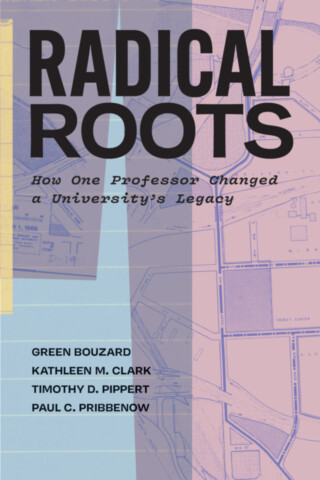
E-books are now distributed via VitalSource
VitalSource offer a more seamless way to access the ebook, and add some great new features including text-to-voice. You own your ebook for life, it is simply hosted on the vendor website, working much like Kindle and Nook. Click here to see more detailed information on this process.
Library E-Books
We are signed up with aggregators who resell networkable e-book editions of our titles to academic libraries. These editions, priced at par with simultaneous hardcover editions of our titles, are not available direct from Stylus.
These aggregators offer a variety of plans to libraries, such as simultaneous access by multiple library patrons, and access to portions of titles at a fraction of list price under what is commonly referred to as a "patron-driven demand" model.
Radical Roots: How One Professor Changed a University's Legacy tells the story of Joel Torstenson, a sociology professor at Augsburg University in Minneapolis, Minnesota. In the 1960s, Torstenson challenged his university to embrace its urban setting and to design its curricular, co-curricular, and community engagement programs to advance its mission of “Education for service.” The compelling story of Torstenson’s legacy at Augsburg over the past 60 years offers lessons for colleges and universities across the country committed to democratic engagement in their work at the intersections of mission and place. Augsburg University's saga as an urban settlement has not always been embraced by the university. Though location and place are central to the university’s identity, it is not sufficient to explain the integrative power of the university’s character. For that purpose, it is critical that place be understood through the lens of Augsburg’s academic mission and work. This integrated view of place and mission required a new way of imagining the university’s core work of educating students. The purpose of this book is two-fold. The first is to document and celebrate the legacy of Professor Joel Torstenson, and to understand the impact of this legacy’s inception, evolution, and current manifestations and impact at Augsburg and in the wider world. Professor Torstenson cared deeply about the public purpose of higher education, and Torstenson’s model for what this public purpose might look like prompted massive transformation in Augsburg University’s trajectory. The resulting experiments in education and commitment to the city flowered into a legacy that has spurred Augsburg University to create an innovative model for 21st Century education. This model has impacted everything from student learning and community life, to teaching and curricular structure, to the public mission of the institution and its presence in the city and world. Torstenson’s creative—and even radical—work in the 1960s and '70s has been carried through the decades by continued innovation in teaching and learning based in experiential education, and a commitment to place and community building. This legacy has simultaneously advanced the public purpose and mission of the University. Secondly, this book shares what are some of the lessons learned from fifty years of innovation following Torstenson’s vision, with the hope that these lessons might serve the broader community of colleges, universities, faculty, staff, and students engaged in similar pursuits. Augsburg’s innovative experiential education, place-based community engagement, and public and anchor institution work has been and will continue to be a model for other institutions. We believe that Torstenson’s legacy, and the lessons learned through the years of its evolution, has lessons to teach and models to follow for our sibling institutions across the United States. The volume includes discussion prompts and questions after each section. There is also a companion website (www.augsburg.edu/radicalroots) that includes additional resources related to the volume's themes.Perfect for course such as: Higher Education and Democracy in the United States; Principles of Experiential Education; Place Matters: Higher Education and Community Engagement; Universities as Anchor Institutions in their Communities; Introduction to Citizen Professionalism: Leading in the 21st Century; Public Work, Social Responsibility, and Vocation in a World of Extremes; Accompaniment: Developing Democratic Skills and Fostering Healing with Communities; Curricular Innovations in Higher Education; and Principles of Higher Education Pedagogy
More