

Search results for using data

E-books are now distributed via VitalSource
VitalSource offer a more seamless way to access the ebook, and add some great new features including text-to-voice. You own your ebook for life, it is simply hosted on the vendor website, working much like Kindle and Nook. Click here to see more detailed information on this process.
Library E-Books
We are signed up with aggregators who resell networkable e-book editions of our titles to academic libraries. These editions, priced at par with simultaneous hardcover editions of our titles, are not available direct from Stylus.
These aggregators offer a variety of plans to libraries, such as simultaneous access by multiple library patrons, and access to portions of titles at a fraction of list price under what is commonly referred to as a "patron-driven demand" model.
Researchers working to clearly identify a research topic and theme have difficulty deciding how to focus their work. Using a potential-based learning focus, detailed in this text, readers are challenged to consider their role as researcher, scholar, and leader to guide their reflective work. Transformative Potential Based Research: A Guide to Successfully Finding One's Place in Research provides both the theoretical support and the guiding activities to help readers decide on an area of potential-based research. The result will prove to be transformational. To guide this work, Karen Moroz and Trish Harvey have developed a suitable framework. They invite readers to review the mountain metaphor shared within the framework and to keep the visual present at all times as they progress through the book. It is addressed often and readers will be invited to use, extend, and discuss it numerous times throughout their journey. Transformative Potential Based Research supports instructors and students through all stages of research, including: identifying and embracing relevant and essential topics, crafting research questions that accurately and concisely convey the purpose(s), exploring one’s own connection to the issue, developing and employing individual processes that lead to success, and determining a potential-based frame that motivates the writer and frames the workPerfect for courses such as: Dissertation; Research Methods; Educational Methods; Intro to Research Design; Academic Writing; Capstone Practicum; Educational Research; Understanding Research
More
E-books are now distributed via VitalSource
VitalSource offer a more seamless way to access the ebook, and add some great new features including text-to-voice. You own your ebook for life, it is simply hosted on the vendor website, working much like Kindle and Nook. Click here to see more detailed information on this process.
Library E-Books
We are signed up with aggregators who resell networkable e-book editions of our titles to academic libraries. These editions, priced at par with simultaneous hardcover editions of our titles, are not available direct from Stylus.
These aggregators offer a variety of plans to libraries, such as simultaneous access by multiple library patrons, and access to portions of titles at a fraction of list price under what is commonly referred to as a "patron-driven demand" model.
Teaching Improvement Science in Educational Leadership: A Pedagogical Guide presents the reader with a range of pedagogies from a variety of viewpoints and approaches. The book provides a holistic picture for how one might develop stakeholder competency and capacity with improvement science as a signature problem-solving methodology for educational leaders. And while there are books that provide foundational knowledge on the field of improvement science (including the list of titles from Myers Education Press), this book differs in that it presents varying approaches for teaching others about improvement science. For those who want to develop the methodology but who need resources, the book provides the illustrations, examples, and other concrete applications so that those involved in teaching the subject matter can connect foundational knowledge of improvement to the applied context. This book serves as the guide for education leaders who wish to have the know-how for developing the knowledge, skills and dispositions relative to the field of improvement science—the education leader’s signature problem-solving methodology.To learn more about Improvement Science and see our full list of books in this area, please click through to the Myers Education Press Improvement Science website.Perfect for courses such as: Introduction to Improvement Science | Educational Research for Administrators | Introduction to Program Evaluation | Action Research for School
More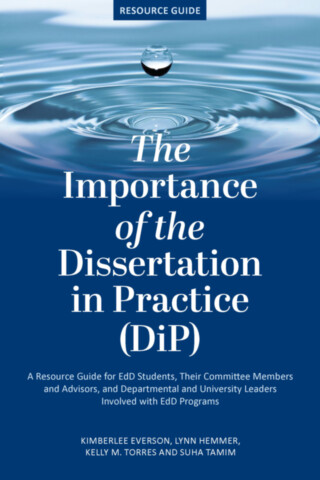
E-books are now distributed via VitalSource
VitalSource offer a more seamless way to access the ebook, and add some great new features including text-to-voice. You own your ebook for life, it is simply hosted on the vendor website, working much like Kindle and Nook. Click here to see more detailed information on this process.
Library E-Books
We are signed up with aggregators who resell networkable e-book editions of our titles to academic libraries. These editions, priced at par with simultaneous hardcover editions of our titles, are not available direct from Stylus.
These aggregators offer a variety of plans to libraries, such as simultaneous access by multiple library patrons, and access to portions of titles at a fraction of list price under what is commonly referred to as a "patron-driven demand" model.
The Importance of the Dissertation in Practice (DiP): A Resource Guide for EdD Students, Their Committee Members and Advisors, and Departmental and University Leaders Involved with EdD Programs is the first book-length study that looks at the elements of high-quality Dissertations in Practice (DiPs). It serves as a resource for EdD students, their committee members, their advisors, and departmental or university leaders involved with EdD programs. The book can be used to improve support from key stakeholders within EdD programs for the implementation of the DiP in the development of practitioner-scholars. The first section of the book discusses the difference between the DiP and traditional dissertations, the history of the DiP, and how the practitioner-scholar is developed through the DiP process. Next, the book describes the elements that are reflective of a high-quality DiP. Finally, it addresses a few of the unique formats that are sometimes used with the DiP, some of the practical issues with implementing the DiP, and issues of the future including the use of artificial intelligence. The ultimate goal of The Importance of the Dissertation in Practice is to serve as a practical guide for all those involved with the DiP, reflecting the editors’ and authors’ experiences working with students within a variety of higher education institutions.Perfect for courses such as: Introduction to Research Methods (doctoral level); Improvement Science; Applied Research Methods; Advanced Research Methods; Introduction to the Dissertation; Educational Evaluation; Theory of Change in Education; Educational Policy
More
E-books are now distributed via VitalSource
VitalSource offer a more seamless way to access the ebook, and add some great new features including text-to-voice. You own your ebook for life, it is simply hosted on the vendor website, working much like Kindle and Nook. Click here to see more detailed information on this process.
Library E-Books
We are signed up with aggregators who resell networkable e-book editions of our titles to academic libraries. These editions, priced at par with simultaneous hardcover editions of our titles, are not available direct from Stylus.
These aggregators offer a variety of plans to libraries, such as simultaneous access by multiple library patrons, and access to portions of titles at a fraction of list price under what is commonly referred to as a "patron-driven demand" model.
The concept of difference occupies a central place in the philosophy of Gilles Deleuze. In this work, David Bright explores how Deleuze’s difference can be put to work in critical qualitative research. The book explores research and writing as a creative process of dynamically pursuing problems. Following Deleuze’s advice not to think of problems in terms of solutions, the book offers important methodological insights into the ways the subjects, objects, and processes of research might be conceived and represented in writing, exploring the problem of thinking and writing about difference in complex ways without reducing thought to static representations of identity. Bright uses the example of foreign teachers and international schooling in Vietnam to show us how Deleuze’s difference can be used in critical qualitative research, demonstrating the limits of traditional ways of thinking about difference in learning and teaching. Exploring Deleuze's Philosophy of Difference is a book that will interest all those with an interest in the application of Deleuze’s philosophy to critical qualitative research.
More
E-books are now distributed via VitalSource
VitalSource offer a more seamless way to access the ebook, and add some great new features including text-to-voice. You own your ebook for life, it is simply hosted on the vendor website, working much like Kindle and Nook. Click here to see more detailed information on this process.
Adapt and Thrive: Strategies for Inclusive and Special Education is a compassionate, evidence-based guide for teachers, special educators, and caregivers supporting children with autism and sensory or behavioral challenges. Tara Cosco provides educators and caregivers with strategies to help each child flourish with dignity, joy, and confidence. Success begins with building strong relationships, understanding students’ strengths, interests, and what brings them joy. You’ll learn ways to determine the cause of challenging behaviors, then respond with motivation, engagement, and personalized support. Sensory needs are treated as essential, not optional: the book guides you in integrating movement and using visual and tactile tools so students feel safe, regulated, and understood. Emotional regulation is also central: with strategies like Zones of Regulation and restorative practices, the goal is equipping students with self-awareness and empathy rather than enforcing compliance.Because every learner is unique in pace, style, level, and readiness, Adapt and Thrive offers flexible strategies. It emphasizes early intervention, providing communication tools, sensory accommodations, and emotional regulation strategies early to help prevent frustration, isolation, and shame. Practical, classroom-tested tools are woven throughout: reward charts, visuals, regulation strategies, and restorative conversation templates. Written with warmth, humility, and respect, this book celebrates the inherent worth and beauty of every child. If you want to build inclusive, compassionate classrooms where every learner is known, valued, and supported, this book will guide your way.Adapt and Thrive can be adopted in a variety of classroom courses, including:Selected Topics in Special EducationAdvanced Studies in Special EducationPolicies and Procedures in Special EducationCollaboration and Consultation in Special EducationAdvanced Assessment in Special EducationStudent Teaching in Special EducationInstructional Strategies for Teaching Students with DisabilitiesEducational Planning for Exceptional StudentsCritical Issues in Education
More
E-books are now distributed via VitalSource
VitalSource offer a more seamless way to access the ebook, and add some great new features including text-to-voice. You own your ebook for life, it is simply hosted on the vendor website, working much like Kindle and Nook. Click here to see more detailed information on this process.
Library E-Books
We are signed up with aggregators who resell networkable e-book editions of our titles to academic libraries. These editions, priced at par with simultaneous hardcover editions of our titles, are not available direct from Stylus.
These aggregators offer a variety of plans to libraries, such as simultaneous access by multiple library patrons, and access to portions of titles at a fraction of list price under what is commonly referred to as a "patron-driven demand" model.
Reclaiming the Education Doctorate: A Guidebook for (re)Designing EdD Programs is a practical guide for those seeking to (re)design a professional practice doctorate program in education that prepares Scholarly Practitioners. To tackle the comprehensive change process necessary for (re)designing the EdD, this book will guide the reader with an improvement lens that looks at the roots of the confusion of the EdD, the system that created it, and the framework that helped to reclaim it. Readers will be guided through a backward mapping (re)design process that begins with defining graduate outcomes, maps through the milestones and courses, ends with rethinking the admissions process. Along the way, readers will learn how to design and integrate a dissertation in practice into the curriculum, consider best practices for their program (re)design, and view examples of successful programs. Additionally, to support readers in their (re)design efforts, each chapter will offer exercises, tools, and resources that will guide the process. The book will prove to be an invaluable resource for anyone developing or revising their EdD program. After the opening chapter that explains the mission statement of Reclaiming the Education Doctorate, Jill Perry structures chapters to deal with the full range of issues that impact EdD programs, including: Roots of the EdD ProblemAim: The Professional Practice Doctorate Driving ChangeBackward mapping: beginning with the endThe heart of the program: CurriculumThe beginning: Admitting CandidatesMeasuring ImpactLeading Change
More
E-books are now distributed via VitalSource
VitalSource offer a more seamless way to access the ebook, and add some great new features including text-to-voice. You own your ebook for life, it is simply hosted on the vendor website, working much like Kindle and Nook. Click here to see more detailed information on this process.
An exponentially increasing number of students experience traumatic events in their daily lives. To address this phenomenon, Beginning Within: Marking a New Journey Toward Equity in Trauma-Informed Education Practices delves into the profound impact of adverse childhood experiences (ACEs). It brings together extensive research, thoughtful contemplations, and innovative ideas that shed light on some of the lesser-explored aspects of trauma-informed practices in education. Authors in the book have developed chapters around three guiding models for systemic change: John Kotter’s (1996/2012) Eight-Step Model for Organizational Change; Fallot and Harris’ (2001) Five Guiding Principles of Trauma-Informed Practice; and Smith, et al.'s (2017) five-level Building Equity Taxonomy.The chapters reflect the growth, grief, and galvanizing challenges that have shaped and continue to shape our understanding of equality, safety, and organizational change around trauma-informed educational practices. Hear from authors, experts, and leaders in the education field who are leading the way in systemic change, ranging from the work in Missouri after the shooting of Michael Brown in Ferguson, to university professors and classroom teachers seeking ways to use the past as guideposts toward a new journey of equity in trauma-informed practices, with each step paved by three research-supported tenets for creating a climate of trauma-informed practices, as offered by the editors of the book:The journey to equity begins with a deep dive into each stakeholder's internal beliefs about self-care.Self-care must be a priority, otherwise, caring for students comes at the lasting cost of secondary traumatic stress (STS) and teacher burnout.A sense of well-being must extend beyond the school building and into the community. Whether the reader is a pre-service teacher, a current teacher, an aspiring or current administrator, or an educator preparation faculty member, ideas are shared that can be implemented within a variety of schools, programs, or academic organizations.Perfect for courses such as: Trauma-Informed Education; Trauma-Informed Teaching; Foundations of Trauma-Informed Education; Trauma-Informed Practices and Pedagogy; Trauma-Informed Practices and Resilience; Trauma-Informed Classroom Teachers; Introduction to Becoming a Trauma-Informed Educator; Trauma-Sensitive Learning Environments; Foundations of Trauma-Informed Practices and Wellness
More
The Instructional Leaders Companion Workbook to Implementation Science: A Playbook for Instructional LeadersThis companion workbook, aligned to the three components of Implementation Science, Enabling Context, Effective Practices, and Effective Implementation, is a hands-on resource designed to help educators, instructional leaders, and district teams bring implementation science principles to life in real-world educational settings. The workbook provides structured tools, practical strategies, and real-world examples to bridge theory to practice, ensuring successful, sustainable, and equity-centered improvements in teaching and learning. Leaders will be able to plan, implement, monitor, and assess their chosen intervention. By the end of this workbook, leaders will have a complete strategic plan with all supports to finally reach their intended outcomes.Enabling Context focuses on creating the conditions for effective and lasting change, providing protocols, planning tools, and team-building activities to build capacity and align resources across leadership, staff, and support teams.Effective Practices translates research-based instructional strategies into actionable steps for the classroom, supporting continuous improvement through cycles of planning, implementation, and refinement.Effective Implementation guides teams through the entire process of planning, executing, monitoring, and assessing new initiatives, offering practical frameworks and data-informed decision-making tools to drive meaningful change.Whether used individually or together with Implementation Science: A Playbook for Instructional Leaders, this workbook empowers educators and leadership teams to create cohesive plans, collaborate effectively, and ensure their efforts lead to measurable improvements in student outcomes.CLICK HERE TO BUY THE PLAYBOOK/WORKBOOK BUNDLE AND SAVE!Perfect for courses in: Foundations of Implementation Science in Education; Instructional Leadership and School Improvement; Curriculum Design, Adoption, and Implementation; Data-Driven Decision Making for Educational Leaders; Systems Change and Continuous Improvement; Strategic Planning for K-12 Educational Initiatives; Evidence-Based Practices in Teaching and Learning; Educational Change Management and Policy Implementation; School Leadership and Organizational Effectiveness; Professional Development and Coaching for Educators.
More
E-books are now distributed via VitalSource
VitalSource offer a more seamless way to access the ebook, and add some great new features including text-to-voice. You own your ebook for life, it is simply hosted on the vendor website, working much like Kindle and Nook. Click here to see more detailed information on this process.
Walking the Doctoral Trail: A Fully Relatable (and Occasionally Humorous) Guide for Successful Completion and Beyond is not a how-to manual—and that is exactly the point. For many prospective and current doctoral students, beginning a doctorate is one of the most meaningful, and most underestimated, undertakings of their lives. This book meets doctoral sojourners where they are: curious, hopeful, anxious, determined, sometimes discouraged, and often more alone than expected. Rather than offering a prescriptive formula for “how to finish,” it invites readers into honest reflection, grounded conversation, and realistic preparation and action for the doctoral journey as it is truly lived. Co-authored by three doctoral completers, the book reflects decades of experience walking alongside doctoral students as educators, advisors, and practitioner-scholars who understand the academic and personal demands of doctoral life. Together, the authors offer diverse perspectives without promoting a single theoretical, methodological, or disciplinary stance. Using the metaphor of a hiking trail, Walking the Doctoral Trail supports doctoral students across disciplines and program structures and acknowledges that journeys differ in terrain and pacing, yet share common challenges and turning points. Organized into seven chapters representing stages of the doctoral journey, each topic includes reflection, guidance, warnings, trail tales, and space for readers’ own notes. Humor—through original cartoons—is woven throughout, reminding readers they are not alone and that completing the hike is achievable. Ideal for doctoral orientation courses and mentoring conversations, this book offers companionship, perspective, wisdom, and steady encouragement for those committed to walking the doctoral trail to the end. It will be a meaningful gift for someone considering—or beginning—a doctorate program as well! Walking the Doctoral Trail is an invaluable tool for every doctoral student, regardless of the stage that they find themselves in in their program.Perfect for courses such as: Introduction to Doctoral Education; Doctoral Research Seminar; Dissertation/Thesis Proposal Writing; Doctoral Dissertation Seminar; Foundations of Social Science Research; Foundations of Behavioral Science Research; Foundations of Organizational and Leadership Research; Introduction to Educational Research; Doctoral Mentoring and Advising; Inquiry as Practice
More
E-books are now distributed via VitalSource
VitalSource offer a more seamless way to access the ebook, and add some great new features including text-to-voice. You own your ebook for life, it is simply hosted on the vendor website, working much like Kindle and Nook. Click here to see more detailed information on this process.
Scaffolding the Language of Power: An Apprenticeship in Writing the Dissertation in Practice extends the interactive and supportive approach of the original Scaffolding the Language of Power to the unique genre demands of the Dissertation in Practice (DiP), the capstone of the Project on the Education Doctorate (CPED)-aligned Education Doctorate. Like its predecessor, the book is grounded in three interconnected commitments: doctoral writing as social justice, as genre, and as scaffolding. However, in this edition, original author Kathryn Strom teams up with CPED Executive Director Jill Alexa Perry to reimagine that framework for scholarly practitioners with professional knowledge, practical wisdom, and contextual change agendas that are central to the work of the dissertation. The book’s unique design features stem from our understanding of the DiP as a distinct form of doctoral inquiry oriented toward understanding, improving, and leading change within a specific practice context and in service of particular communities. Accordingly, this volume emphasizes the dual-audience nature of the DiP: although students write to their committee first, DiP work simultaneously needs to serve a practitioner/professional community. To achieve that, for example, scaffolds for organization, headings, and topic sentences are framed not only as tools for writing, but also for producing writing that is accessible to multiple audiences beyond academia. Second, the book maintains a practice-to-improvement arc, reminding readers throughout that their writing is building toward something that they will be implementing, evaluating, and acting on. Third, the book is written to honor the highly contextual nature of the DiP, helping writers achieve the specificity needed to make local work understandable and transferable to readers in other settings. Finally, the volume explicitly affirms a scholar-practitioner identity, positioning professional knowledge in dialogue with scholarly knowledge rather than as something requiring academic legitimization. These design features support readers while guiding them to complete the specific tasks of the dissertation in practice, which includes articulating a problem of practice grounded in organizational urgency and stakeholder impact; constructing a review of scholarly and professional knowledge; and using that literature to create a theory of action and contextual plan of intervention. The book focuses on applied research, with specific guidance for three methodologies most common to CPED-aligned programs, Action Research, Improvement Science, and Program/Practice Evaluation. As in the original volume, each chapter follows a carefully sequenced structure that includes warm-up reflections, explicit instruction in the genre's linguistic moves, annotated modeling, and scaffolded exercises that build systematically toward independent writing. Many examples are drawn from CPED-aligned dissertations, giving readers models that reflect the scholarship of practice central to their own doctoral work. Ultimately, the book provides an affirmative apprenticeship that honors practitioners' existing expertise while making visible the often-hidden rules of academic writing, helping scholarly practitioners build confidence in their writing and facilitating the dissemination of impact in service of local change.This title is part of a series--the first volume, Scaffolding the Language of Power: An Apprenticeship in Doctoral Level Writing and the Companion Workbook are available as a bundle.
More